Professional Hood & Exhaust System Cleaning for Restaurants
Certified kitchen exhaust cleaning services for restaurants, commercial kitchens, cafeterias, and food service facilities throughout Dallas-Fort Worth. Our IKECA-certified technicians thoroughly clean hoods, ducts, and fans to remove hazardous grease buildup, ensure fire code compliance, and maintain optimal ventilation performance.
Service Features
Hood & Filter Degreasing
Complete cleaning of exhaust hood interiors, exteriors, and removable filters to remove accumulated grease. Filters are removed, soaked in degreasing solution, pressure washed, and thoroughly dried before reinstallation. Hood surfaces are scraped and cleaned to bare metal, removing all fire-hazardous grease deposits.
Ductwork Cleaning
Thorough cleaning of exhaust ductwork from hood to fan, accessing all horizontal and vertical runs. We use scraping tools, pressure washing, and specialized equipment to remove grease buildup from duct interiors. Access panels are installed where needed to ensure complete system cleaning and future serviceability.
Exhaust Fan Maintenance
Rooftop and inline exhaust fans are accessed, blades and housings are degreased, and motors are inspected. Fan belts are checked and adjusted, electrical connections verified, and overall fan condition assessed. Proper fan operation is essential for effective ventilation and code compliance.
Rooftop Grease Containment
Grease containment systems on rooftops are cleaned and maintained to prevent environmental contamination and fire hazards. We ensure containment devices are properly functioning and comply with EPA requirements for preventing grease discharge onto roofs and into stormwater systems.
Fire Code Compliance Service
Our cleaning protocols follow NFPA 96 standards and local fire code requirements. We understand the specific cleaning frequencies mandated by code based on cooking volume and type. Service is performed to standards that satisfy fire marshal inspections and insurance requirements.
Photo Documentation & Reporting
Complete before and after photo documentation provides visual evidence of cleaning thoroughness. Detailed service reports document areas cleaned, deficiencies noted, and certification of compliance. These records support your fire inspection preparation and insurance documentation needs.
Benefits of Kitchen Exhaust Cleaning
Fire Hazard Reduction
Grease accumulation in exhaust systems is a leading cause of restaurant fires. According to the National Fire Protection Association, cooking equipment is involved in 61% of restaurant fires, with failure to clean being a major contributing factor. Thorough exhaust cleaning removes this fuel source, dramatically reducing fire risk and protecting lives and property.
Fire Code Compliance
NFPA 96 and local fire codes mandate regular kitchen exhaust cleaning based on cooking volume. Failure to comply can result in fines, business closure, and liability exposure. Professional cleaning by certified technicians ensures you meet regulatory requirements and can demonstrate compliance during inspections.
Improved Ventilation Efficiency
Grease buildup restricts airflow through exhaust systems, reducing ventilation effectiveness. Poor ventilation leads to heat buildup, uncomfortable working conditions, and accumulation of cooking odors and smoke in dining areas. Clean systems operate at design efficiency, maintaining comfortable kitchen environments and proper air quality.
Insurance Requirement Satisfaction
Restaurant insurance policies typically require regular professional exhaust cleaning as a condition of coverage. Failure to maintain cleaning records can result in claim denials if fire occurs. Professional service with proper documentation ensures you meet insurance requirements and maintain coverage protection.
Extended Equipment Life
Grease accumulation causes corrosion, motor strain, and premature wear of exhaust system components. Regular cleaning removes these damaging deposits and allows inspection of equipment condition. This maintenance extends system life, reduces repair costs, and prevents unexpected equipment failures during busy periods.
Health Department Compliance
While primarily a fire safety issue, exhaust system condition also affects health inspections. Poor ventilation contributes to heat stress, inadequate air quality, and grease accumulation on surfaces. Clean exhaust systems support overall kitchen sanitation standards and health department compliance.
Our Kitchen Exhaust Cleaning Process
Pre-Service Inspection & Setup
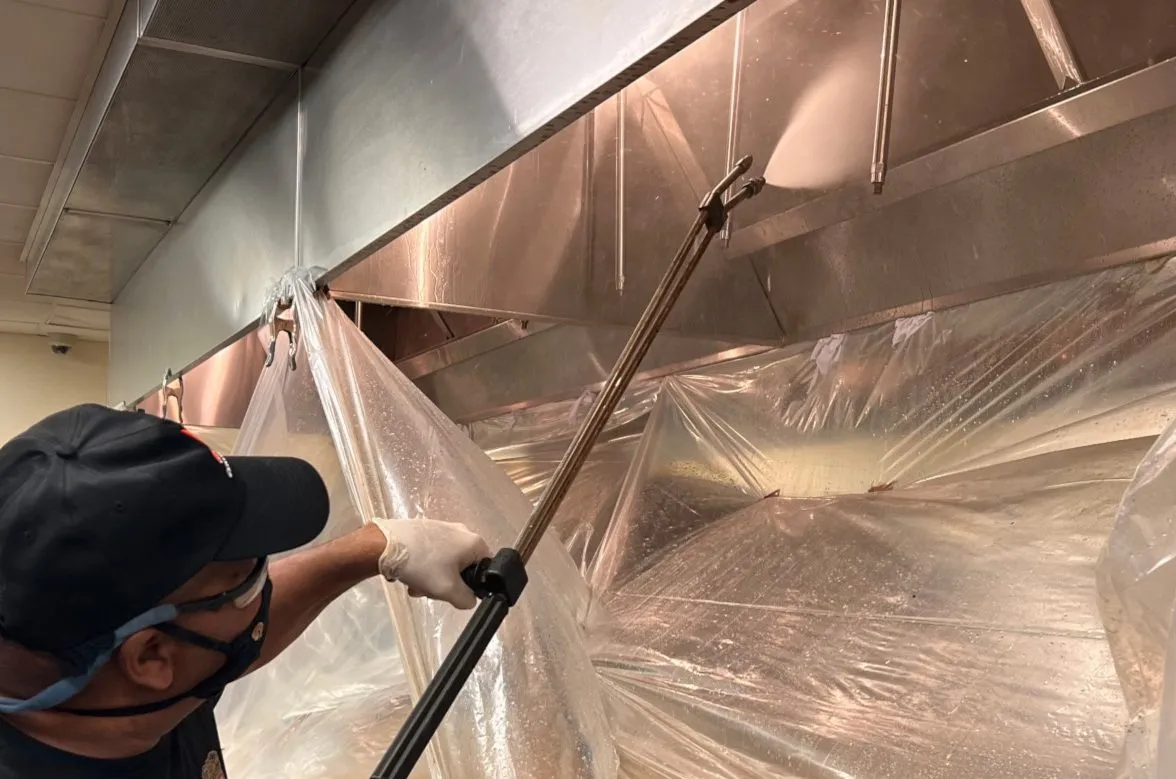
Our certified technician inspects the exhaust system, identifies access points, evaluates grease accumulation, and determines appropriate cleaning methods. Kitchen equipment is protected with plastic sheeting, drop cloths are placed to catch debris, and necessary access panels are opened or installed.
Filter Removal & Cleaning
All baffle filters are carefully removed from the hood and transported outside or to a designated wash area. Filters are soaked in hot degreasing solution, pressure washed to remove all grease, rinsed thoroughly, and air dried. This process restores filter function and fire protection capability.
Hood Interior Scraping & Cleaning
Hood interiors, plenums, and accessible ductwork are scraped to remove heavy grease buildup. Special tools reach into corners and crevices where grease accumulates. Scraped grease is collected for proper disposal. Pressure washing or chemical cleaning follows scraping to remove remaining residue and leave surfaces clean to bare metal.
Ductwork Cleaning
Ductwork is accessed through existing openings or installed access panels. Scraping tools, rotary brushes, pressure washing, and vacuum systems remove grease from horizontal and vertical duct runs. We ensure complete cleaning from hood connection to fan inlet, addressing all areas where fire hazards exist.
Fan Cleaning & Inspection
Rooftop or inline exhaust fans are accessed and thoroughly cleaned. Blades, housings, and motors are degreased. Fan operation is tested, belts inspected and adjusted, and overall condition assessed. Any deficiencies are noted for your attention. Fan cleaning ensures proper airflow and prevents motor overheating.
Cleanup, Documentation & Certification
The kitchen is thoroughly cleaned of any debris or overspray from the service. Before and after photos are taken to document cleaning results. A detailed service report and certificate of compliance are provided for your records. Filters are reinstalled and the system is checked for proper operation.
Understanding the Fire Hazards of Grease Accumulation
NFPA 96 Standards and Code Compliance
The Kitchen Exhaust Cleaning Process and Technology
Kitchen Exhaust System Components and Maintenance Requirements
Frequently Asked Questions
How often does kitchen exhaust cleaning need to be performed?
NFPA 96 establishes cleaning frequencies based on cooking volume and type. Solid fuel cooking (wood, charcoal) requires monthly cleaning. High-volume operations like 24-hour restaurants need quarterly service. Moderate-volume cooking requires semi-annual cleaning, and low-volume operations like churches or seasonal facilities need annual service. Dallas Fire Code adopts these standards. We assess your specific cooking operations and recommend appropriate frequency to maintain compliance and safety.
What certifications should a kitchen exhaust cleaning company have?
Look for IKECA (International Kitchen Exhaust Cleaning Association) certification, which is the industry standard for kitchen exhaust cleaning professionals. IKECA-certified companies follow established standards, use proper techniques and equipment, and employ trained technicians. Membership in the National Air Duct Cleaners Association (NADCA) also indicates professional commitment. Proper insurance including general liability and workers compensation is essential. Ask for references from other restaurants they service.
Will kitchen exhaust cleaning disrupt our restaurant operations?
We schedule service at times that minimize operational impact, typically after closing or during prep hours before service begins. The kitchen cannot be used for cooking during cleaning due to equipment protection and safety requirements. Most services are completed in 2-6 hours depending on system size and condition. We work with your schedule to find the optimal service window. Emergency service is available if situations require immediate attention.
What happens if we don't clean our kitchen exhaust system regularly?
Neglecting exhaust cleaning creates serious consequences. Fire risk increases dramatically as grease accumulation becomes fuel for potentially devastating kitchen fires. Insurance claims may be denied if cleaning records cannot be demonstrated. Health and fire inspections can result in citations, fines, or mandatory closure until compliance is achieved. Poor ventilation creates uncomfortable, potentially dangerous working conditions. Equipment life is shortened due to grease-related corrosion and strain. The risks and costs of neglect far exceed the investment in regular professional cleaning.
Do you install access panels for duct cleaning?
Yes, when exhaust systems lack adequate access for thorough cleaning, we install code-compliant access panels at appropriate intervals. NFPA 96 requires access every 12 feet horizontally and at every change of direction. We install these panels as part of our service when needed, ensuring future cleanings can be performed effectively and that your system meets code requirements. Panel installation is discussed and approved before proceeding.
How do I know if my exhaust system needs cleaning?
Visible grease accumulation on hood filters, visible grease in ductwork visible through access panels, reduced airflow from exhaust fans, excessive heat in the kitchen, grease dripping from seams, or grease odors indicate cleaning is needed. However, waiting for visible signs means the system is already significantly contaminated. Following the NFPA 96 schedule for your cooking volume is the safest approach, as much of the fire-hazardous grease accumulation occurs in ductwork that cannot be seen during normal operations.
Related Services
Tile & Grout
Deep cleaning and restoration for commercial tile floors, walls, and grout lines.
Warehouse Cleaning
Industrial cleaning for warehouses including dust removal and debris cleanup.
Post-Construction Cleanup
Complete cleaning after construction, renovation, and remodeling projects.
Restroom Sanitation
Deep cleaning and disinfection services for commercial restrooms and washrooms.
Ready to Experience the Difference?
Contact us today for a free consultation and customized quote for kitchen exhaust cleaning.
services planning guide
How to plan commercial kitchen exhaust cleaning for a commercial facility in Dallas
Commercial Cleaning Services of Dallas uses the following planning framework to help property managers and business owners turn a request for commercial cleaning and janitorial service into a scope that can be walked, priced, scheduled, and checked. It is designed for practical comparison and does not replace site-specific safety, material, vendor, or regulatory requirements.
Define the Work Before Pricing It
Before pricing commercial kitchen exhaust cleaning, document exclusions as carefully as inclusions. Exterior work, high access, consumable supplies, waste handling, specialty floor restoration, equipment interiors, and event cleanup can be scheduled correctly only when responsibility is explicit. For multi-tenant or mixed-use properties, commercial kitchen exhaust cleaning should be divided by responsibility zone. Common areas, tenant suites, back-of-house spaces, loading areas, public restrooms, and restricted rooms can then receive schedules and approval rules that match their actual use. The strongest commercial kitchen exhaust cleaning plan names measurable outcomes rather than relying on broad phrases such as “keep it clean.” Examples include streak-free entry glass, stocked and odor-controlled restrooms, debris-free floor edges, sanitized touchpoints, and completion before a stated opening time. Change orders are easier to avoid when the initial commercial kitchen exhaust cleaning proposal records current conditions. Photographs, floor-type notes, access limitations, and known buildup give both sides a shared baseline for deciding what belongs in startup work and what belongs in recurring maintenance.
Build the Schedule Around Operations
Scheduling should be built around operating hours and risk, not around the cleaning company’s convenience. Some commercial facility environments need a complete after-hours reset, while others benefit from daytime attention to entrances, restrooms, spills, or high-traffic common areas. Daytime and after-hours service solve different operational problems. Day porter coverage manages visible conditions while people are present; after-hours crews complete disruptive or time-intensive tasks when work areas can be accessed safely and thoroughly. A dependable plan includes a method for reporting schedule changes. The facility contact should know whom to notify, how much lead time is needed, and how missed or added visits affect the monthly program before an urgent request arises. Facilities with irregular occupancy should use a flexible service calendar. Seasonal traffic, events, construction phases, tenant move-ins, inventory cycles, and weather can all create temporary cleaning demand that a rigid schedule will miss.
Make Quality Control Observable
Quality control works best when it is tied to the site-specific scope. A supervisor can inspect completion against named rooms and outcomes, record exceptions, assign corrections, and identify patterns that require a change in staffing, tools, or frequency. Before-and-after documentation is especially valuable for one-time or restorative commercial kitchen exhaust cleaning. It establishes the starting condition, records the completed result, and helps the facility manager decide whether a recurring maintenance cycle would prevent the same buildup. Consistent crew assignments improve commercial kitchen exhaust cleaning because the team learns access routines, material sensitivities, recurring problem areas, and the expectations of the facility contact. Coverage plans are still necessary for absences so consistency does not depend on one individual. Inspection frequency should reflect the complexity of the account. A small weekly office may need periodic supervisory review, while a high-traffic or regulated environment may require documented checks several times each week.
Match Methods to Materials and Risk
For sensitive or newly installed materials, a small test area can prevent expensive mistakes. The service plan should identify who approves the test result before broader cleaning or restoration proceeds. Dwell time and physical removal are central to effective cleaning. A product cannot perform as intended if it is wiped away immediately, and loosened soil still needs to be removed with clean tools rather than redistributed across the surface. Color-coded cloths, pads, and tools can reduce cross-use between restrooms, food areas, workspaces, and public surfaces. The exact system matters less than having a documented method the crew can follow consistently. Equipment should be selected for the facility rather than for convenience. HEPA filtration, low-moisture extraction, auto-scrubbing, water-fed poles, pressure equipment, or detail tools may be appropriate depending on access, surface, soil, and reopening time.
Use the Walkthrough to Build the Scope
Access and safety constraints should be demonstrated, not merely mentioned. Alarm panels, loading doors, restricted areas, waste points, water access, electrical access, and equipment storage can change the labor plan materially. The walkthrough should follow the facility’s traffic pattern from entrances through work areas, restrooms, support rooms, and exits. This reveals where soil enters, where it concentrates, and which tasks must be completed in a particular order. Discuss current service honestly during the walkthrough. What works should be preserved, what fails should be corrected, and any unrealistic expectation should be resolved before it becomes a recurring dispute after startup. A useful walkthrough ends with next steps: who will receive the written scope, who can approve revisions, whether a second technical visit is required, and what information is still needed before pricing is final.
Put the Service Agreement in Writing
A structured startup period gives both sides a chance to refine the scope. Early inspections and a scheduled review after the first few visits can resolve workload assumptions before they become embedded in a long-term program. Pricing should state whether it is monthly, per visit, hourly, or project based and should identify the assumptions behind it. Changes in occupied square footage, frequency, access time, or task scope need an agreed method for repricing. The agreement should explain how additional work is approved. Emergency cleanup, event service, construction dust, floor restoration, and extra porter coverage should not be performed or billed through an informal request that no one can later verify. Cancellation, renewal, and notice terms deserve the same attention as the cleaning checklist. A facility manager comparing proposals should understand the initial term, renewal method, price-review process, and the notice required to change or end service.
Plan for Dallas Facility Conditions
A local service plan should account for the property’s immediate environment. Construction nearby, open parking, landscaping, loading activity, and pedestrian traffic can change how quickly dust and debris return after a visit. Dallas facilities contend with long cooling seasons, tracked-in dust, pollen, severe-weather debris, and rapid development activity. Those conditions can influence entry cleaning, high dusting, floor care, glass maintenance, and the timing of periodic deep work. Fast regional growth creates frequent move-ins, renovations, tenant turnovers, and occupancy changes. The cleaning scope should be reviewed when a property changes use instead of assuming the previous tenant’s schedule remains appropriate. Commercial properties in the region frequently combine offices, warehouses, showrooms, food service, or public-facing areas under one address. Zoning the scope by use keeps the cleaning method appropriate for each part of the building.
Compare Providers on More Than Price
Review the proposal for vague language. Terms such as “as needed,” “regularly,” and “periodically” should be converted into frequencies, triggers, or approval rules before the agreement is signed. A pilot or structured startup can be useful when the facility is complex or the current condition is uncertain. Define what will be evaluated, how long the evaluation lasts, and what information determines the permanent scope. Ask each provider to explain staffing assumptions, visit length, supervision, equipment, and the process for covering absences. The answer reveals whether the proposal is an operating plan or simply a price attached to a task list. The final decision should align service frequency with the facility’s real use. Buying fewer visits than the property needs creates visible decline; buying unnecessary frequency wastes budget that could be directed to periodic or high-priority work.
Start, Measure, and Adjust the Program
Task sequencing affects results. High dusting should precede lower-surface cleaning, dry soil removal should precede wet work, and areas with restricted reopening times should be completed early enough to dry or ventilate. The first visit should not be treated as an ordinary maintenance visit when buildup already exists. Startup cleaning establishes a maintainable baseline and gives the crew a realistic view of the time required for future service. Crew orientation should cover the approved scope, building access, material cautions, waste handling, supply storage, security, and the communication path for exceptions. Written information is more dependable than verbal instructions passed between shifts. Periodic tasks should be placed on a calendar at startup. Floor work, carpet extraction, glass detailing, vent cleaning, high dusting, pressure cleaning, and other rotating services are easier to budget when dates are planned.
Bring to the walkthrough
- Approximate square footage, floor plan, and operating hours
- Current frequency, known complaints, and priority areas
- Flooring and surface notes, restricted rooms, and access rules
- Desired start date, budget constraints, and approval contacts
Expect in a written proposal
- Task scope by zone and visit frequency
- Service windows, periodic work, and supply responsibility
- Quality checks, communication, and correction procedures
- Pricing assumptions, exclusions, and change-order rules